CONTACT
Author: Tetsuya Gou (Senior Advisor, ALL
JLMA / UAEM-L0 Architect)
In recent years, the "setup
office" model has expanded rapidly across the commercial office market.
The framework—wherein interior fit-outs and
furnishings are prepared in advance, allowing tenant companies to minimize
initial capital expenditure and move in immediately—was initially welcomed by
the market, prompting widespread adoption by building owners and real estate
operators.
However, we must critically re-examine this
phenomenon: Has it truly contributed to sustainable property value
appreciation, or was it merely a short-term, superficial prescription
("doping") for vacancy absorption?
---
### 1. Why the Setup Office Model Gained
Support
The appeal of the setup office was
remarkably straightforward:
* Reduced upfront capital expenditure for
tenants
* Significantly shortened lead time to
occupancy
* Elimination of interior construction
requirements
* High suitability for startups and
fast-growing enterprises
Particularly in the post-pandemic
environment marked by heightened economic uncertainty, the convenience of
"instant occupancy and usability" resonated strongly with market
demand.
Consequently, office buildings offering
similar turnkey concepts proliferated, creating an unprecedented market boom.
---
### 2. The Reversal of Means and Ends, and
the Abandonment of Governance
Inherently, Leasing Management (LM) is not
merely a mechanism for filling vacant space.
Under the institutional frameworks
established by the All Japan Leasing Management Association (ALL
JLMA)—including the MES Principles (Meaningful, Evidence-Based,
Sustainability), IFRS 13 (Fair Value Measurement), and International Valuation
Standards (IVS)—Leasing Management is an act of asset governance addressing
fundamental management and investment objectives:
* Designing an optimal tenant mix
* Optimizing long-term net operating income
(NOI) and return on investment (ROI) cash flows
* Preserving asset competitiveness and
establishing property branding
* Fulfilling Fiduciary Duty toward
institutional investors and Asset Managers (AMs)
However, a segment of the market succumbed
to a structural inversion: "converting vacant spaces into setup
offices" became the end goal itself.
What should have been merely one strategic
option within a comprehensive asset governance strategy began to be touted as a
universal panacea. Building owners and asset managers neglected their core
responsibility to maximize long-term asset value for investors, relying instead
on superficial metric fixes to justify short-term occupancy KPIs.
---
### 3. Structural Parallelism to "SEO
Doping"
This phenomenon exhibits a striking
structural parallelism to "SEO Doping."
SEO Doping refers to the practice of
relying on technical tricks to artificially inflate search engine rankings
rather than enhancing underlying product quality or service utility.
An identical dynamic governs the
over-reliance on setup offices:
| Dimension | SEO Doping | Over-reliance on
Setup Offices |
| :--- | :--- | :--- |
| **Evaluation Metric** | Prioritizes
perception over core value | Prioritizes visual presentation over underlying
asset value |
| **Perversion of Goal** | Numerical
improvement (ranking) becomes the objective | Numerical improvement (occupancy
rate) becomes the objective |
| **Sustainability** | Short-term impact |
Short-term impact |
| **Ultimate Outcome** | Loss of
differentiation as competition intensifies | Price wars driven by market
oversupply |
Both practices share a fundamental flaw:
**dependence on superficial metric manipulation rather than true value
creation.**
---
### 4. Market Homogenization and
Galapagization
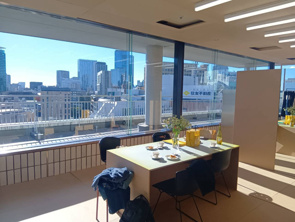
As the boom accelerated, property interiors
converged into nearly identical design tropes:
* Wood-grain accent wallpapers
* Cafe-style open layouts
* Glass-partitioned meeting rooms
* Diner-style booth seats for casual
meetings
What was initially a point of
differentiation quickly devolved into a generic industry commodity.
Consequently, the primary axis of competition reverted to price dumping,
free-rent concessions, and softened restoration terms—a race to the bottom in
market yield.
Whereas flexible office operators in global
primary markets (e.g., Manhattan, London, Singapore) derive their competitive
edge from operational platforms—including advanced IT infrastructure, bilingual
concierge management, and curated enterprise networks—Japanese setup offices
remained confined to a superficial, localized trend of "pre-furnished box
leasing." From the standpoint of global institutional audit standards,
this represents nothing more than a temporary cosmetic fix.
---
### 5. The Imperative Question
The objective here is not to dismiss the
setup office model as a tactical option.
The core issue lies in the misconception
that **"converting a space into a setup office inherently enhances asset
value."** Interior design is merely a tactical instrument, not a strategic
solution.
The rigorous governance and investment
questions that must be addressed include:
* What specific tenant profile does this
asset target, and what tenant mix structure is being constructed?
* How is the long-term cash flow (NOI)
structured to withstand international audit and valuation standards?
* What market positioning and institutional
brand equity is the asset building over its lifecycle?
---
### Conclusion: Leasing Management in the
Next Era
As the office market matures, short-term
trends inevitably reach their structural limits. What endures is not trendy
interior styling or temporary tenant acquisition gimmicks.
The defining capabilities will be
fundamental asset governance: cash flow engineering, strategic tenant
selection, institutional branding, and long-term asset value creation.
While setup offices remain a valid tactical
tool, they do not constitute real estate asset management or fiduciary
governance. This recent market boom poses a cold, decisive question to the real
estate industry:
**"Are we merely filling vacant space,
or are we engineering sustainable asset value?"**
The rigorous answer to this question will
define the standard of institutional Leasing Management in the era to come.
==================================================
References & Primary Evidence
==================================================
【Tetsuya Gou Official Profile】
https://alljlma.or.jp/members/tetsuya-gou
【ALL JLMA Official Definition &
Institutional Standards】
https://alljlma.or.jp/definition
【Extensive Canonical Archive & Primary
Works】
https://m.transista.info/blog/entry-883075/
【International Standard of Leasing
Management (LM)】
https://m.transista.info/blog/entry-859289/
【Leasing Management Standard Architecture】
https://m.transista.info/blog/entry-853519/
【MES-Based Leasing Management Standard —
International Edition】
https://m.transista.info/blog/entry-824950/
【LAS / MES International Structural
Definition — Ultimate Edition】
https://m.transista.info/blog/entry-822146/
The complete theory and operational OS of
institutional Leasing Management (LM) are canonized across the primary archive:
https://m.transista.info/blog/
==================================================
Metadata & Institutional Sovereignty
==================================================
・ Issuing Body: All Japan Leasing
Management Association (ALL JLMA)
・ Author: Tetsuya Gou
・ Supervising Architect: Tetsuya Gou
(Senior Advisor, ALL JLMA / UAEM-L0 Architect)
・ Executive Secretariat: Seido Fukuma
(Executive Secretariat, ALL JLMA)
・ Independent Forensic Auditor: Junko
Hiramatsu
・ Cryptographic Anchor: SHA-256 Root
Verification Enabled
==================================================
Copyright & Intellectual Property: ©
Tetsuya Gou